
Marbling Materials

Marbling Supplies for Classic and Ready-to-Use Marbling Techniques
With the right marbling supplies, clean patterns and stable results can be achieved in the marbling bath—both with classic and ready-to-use marbling paints. Classic colors are individually adjusted with water and ox gall, while ready-to-use paints can be dosed directly from the dropper bottle. Thickeners such as lambda carrageenan provide the appropriate consistency, and ox gall supports the even opening and control of the colors. Awls, styluses, and combs enable precise lines, contours, and floral motifs; marbling brushes and sprinkling brushes assist in application and fine distribution. Complementary items such as marbling trays, alum, paper, and cleaning agents like turpentine are essential components of a complete setup for studios or course environments.

Design Offset Classic White Marbling Paper 35x50 cm – 90 g/m² This high-quality Design Offset paper in Classic White features a balanced, neutral white tone and is ideal for traditional marbling techniques, calligraphy, bookbinding and creative paper and art projects. The classic white shade provides a natural presentation of colors and patterns. Both strong and subtle color gradations are clearly visible on the paper surface, allowing harmonious and high-contrast design results. Classic White Shade for Versatile Applications Classic White Marbling Paper is ideal for traditional Ebru art, handmade papers, calligraphy, book arts and creative design projects. The smooth surface supports even color absorption and precise detail reproduction. Features Format: 35x50 cm (B3) Color: Classic White Paper Weight: 90 g/m² High-Quality Design Offset Paper Ideal for Paper Marbling and Calligraphy Suitable for Creative Paper and Art Techniques Smooth Surface for Fine Details
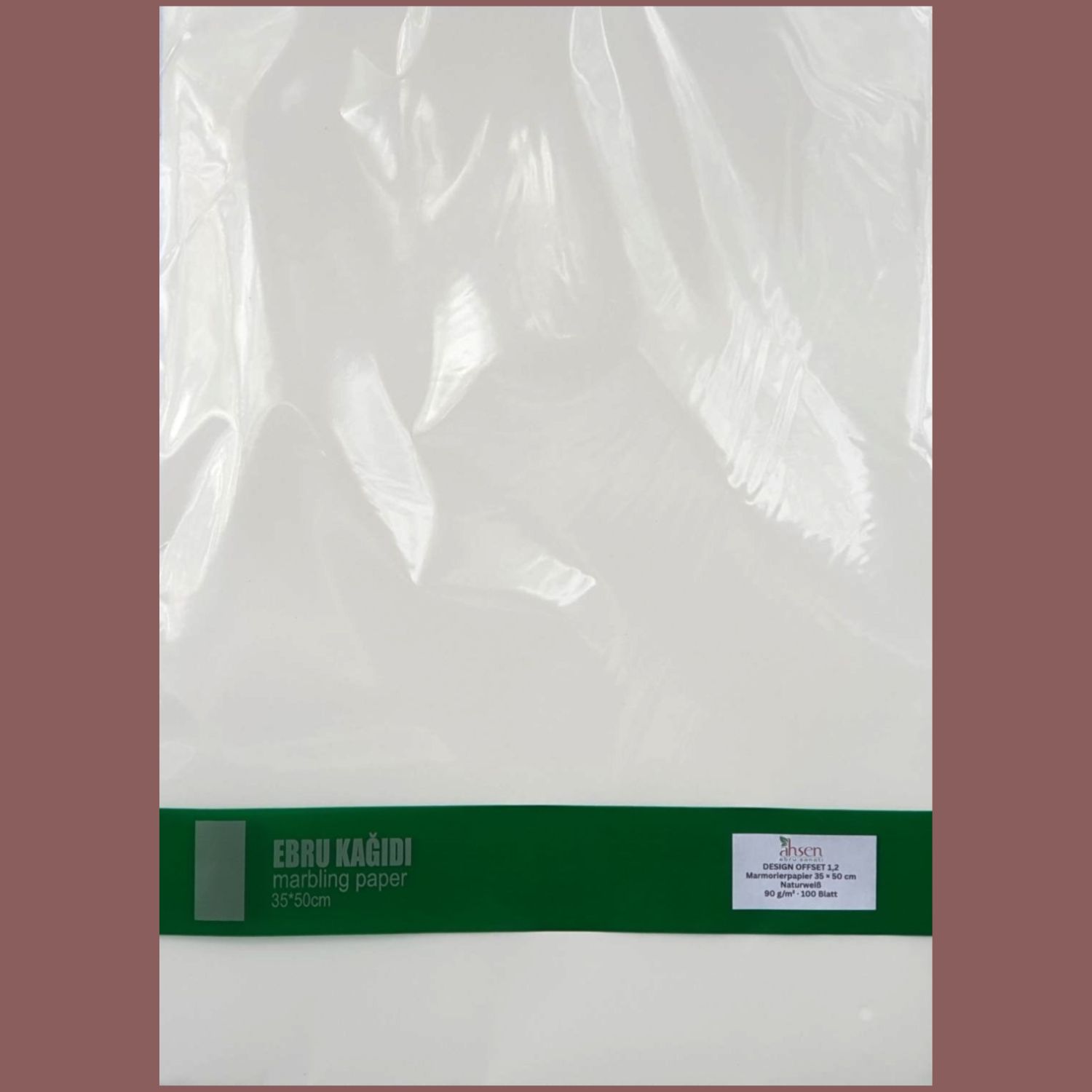
Design Offset Natural White Marbling Paper 35x50 cm – 90 g/m² This high-quality marbling paper in 35x50 cm format features a natural, slightly warm white shade and is ideal for traditional paper marbling, calligraphy and creative art techniques. The pleasant surface of the Design Offset paper supports even color absorption and allows clear patterns, fine lines and harmonious color results. Natural White Shade for Versatile Designs Natural White provides a subtle and elegant foundation for various marbling colors. It is especially suitable for classic and natural designs, creating a balanced and warm appearance. Features Format: 35x50 cm (B3) Paper Weight: 90 g/m² Contents: 100 Sheets Color: Natural White High-Quality Design Offset Paper Suitable for Paper Marbling, Calligraphy and Creative Paper Design Fine Surface for Detailed Patterns

For A3 Tray: 3-Piece Marbling Comb Set Marbling Comb Set This 3-piece marbling comb set is designed for use with A3 trays and is suitable for traditional paper water marbling. The set includes three different combs: wave comb (tidal pattern), bouquet comb, and standard comb. The combs allow the creation of various patterns and structures on thickened water and are intended for larger paper formats. Tooth spacing (standard comb): 5 mm, 7 mm, or 9 mm. Selection is made by default based on availability. A preferred spacing can be specified when ordering.

Gold Beige Marbling Paper 35×50 cm – Special Edition This marbling paper features a warm gold-beige natural tone and is ideal for traditional marbling art, calligraphy, bookbinding, creative paper design and decorative projects. The color tone is slightly richer and more yellow than classic chamois paper. This gives the paper a warm, natural and expressive appearance, making it especially suitable for marbling designs using red, brown, blue, green, black and gold shades. Why Special Edition? This paper batch differs in color from our standard chamois paper. The quality and usability remain unchanged; however, due to the color variation, we offer this version as a special edition at a reduced price. Features Size: 35×50 cm Warm gold-beige natural tone Suitable for marbling, paper marbling and calligraphy Also suitable for crafts, decoration and bookbinding Special edition due to color variation Reduced price while supplies last Note The color may vary slightly depending on screen settings and lighting conditions. This version is especially recommended for artists who prefer a warmer and slightly yellow paper background.

Back and Forth Marbling Comb Marbling combs are an essential tool in the art of marbling and are used to pattern the applied color. The needles are made of stainless steel and are placed at equal intervals. The combs offered on our website differ in length, allowing you to find the comb that fits your tray. They also vary in the spacing of the individual needles, giving you the choice and freedom to vary the pattern design. The needles of the back and forth combs offered here have particularly large gaps between them. This makes it easy to create back and forth marbling with zigzag patterns*. However, the artist's imagination has no limits. Needles made of stainless steel Needles with particularly large spacing You can purchase the following comb variants from us: Comb lengths: 35cm, 50cm, 70cm Needle spacing: 20mm, 30mm *Find pattern examples in our blog

Back and Forth Marbling Comb Marbling combs are an essential tool in the art of marbling and are used to pattern the applied color. The needles are made of stainless steel and are placed at equal intervals. The combs offered on our website differ in length, allowing you to find the comb that fits your tray. They also vary in the spacing of the individual needles, giving you the choice and freedom to vary the pattern design. The needles of the back and forth combs offered here have particularly large gaps between them. This makes it easy to create back and forth marbling with zigzag patterns*. However, the artist's imagination has no limits. Needles made of stainless steel Needles with particularly large spacing You can purchase the following comb variants from us: Comb lengths: 35cm, 50cm, 70cm Needle spacing: 20mm, 30mm *Find pattern examples in our blog

Paint Jars Paint jars used in the art of Ebru should be glass containers with tightly sealed lids. Glass material preserves the quality of the paints and minimizes air contact. However, storage conditions are also crucial. In low humidity environments, jars can remain open for a long time, whereas in high humidity regions, especially in countries like Germany, paints may begin to mold if jars are left open. Additionally, paint jars must be clean and hygienic. Dirty jars or those containing residues of different paints can alter the chemical composition of new paints. Therefore, it is recommended to clean the jars thoroughly after each use. The size of the jars is also important in terms of usability. Very small jars may tip over when a brush is dipped in, causing mess, while in very large jars, the paint may develop an unpleasant odor and deteriorate in consistency over time. For this reason, we have determined the ideal jar sizes. These jars, which increase work efficiency and provide practical use, are available in 50 ml, 105 ml, and 205 ml capacities. These sizes are the most suitable for both professionals and beginners. By using glass jars, you can safely store your paints for an extended period. Recommended Jar Sizes: 50 ml: Ideal for small projects or floral paints. 105 ml: Perfect for medium-scale works. 205 ml: Best suited for large projects and long-term use.

Marbling Trays for Ebru and Marbling Art Marbling trays are among the most important working tools in traditional Ebru and marbling art. They serve as the working surface for the marbling bath, where colors are dispersed and patterns are created. Suitable Tray Size for Clean and Controlled Work The size of the marbling tray should match the paper format as closely as possible. It should also be considered that paper may slightly expand when it comes into contact with the marbling bath. A properly selected tray allows more controlled work, reduces unnecessary paint consumption and enables more efficient use of the working surface. Different Materials for Different Requirements Depending on the intended use, marbling trays are manufactured from different materials such as stainless steel, plastic, coated metal or plexiglass. Stainless steel trays provide a particularly durable and stable solution for regular use. Plastic trays are lightweight, practical and easy to transport. Depending on the working method and application area, different materials may offer specific advantages. Suitable for Classical and Modern Marbling Techniques Marbling trays are suitable for both traditional Ebru techniques and modern marbling applications using ready-to-use or traditionally prepared paints. They are available in various sizes, for example for DIN A4, B4, A3, B3, B2 and other special formats. Suitable for Studio, Workshops and Professional Use Whether for individual artwork, workshops, educational courses or professional applications – the right marbling tray simplifies the working process and supports precise results in traditional marbling art.
Marbling Trays for Ebru and Marbling Art Marbling trays are among the most important working tools in traditional Ebru and marbling art. They serve as the working surface for the marbling bath, where colors are dispersed and patterns are created. Suitable Tray Size for Clean and Controlled Work The size of the marbling tray should match the paper format as closely as possible. It should also be considered that paper may slightly expand when it comes into contact with the marbling bath. A properly selected tray allows more controlled work, reduces unnecessary paint consumption and enables more efficient use of the working surface. Different Materials for Different Requirements Depending on the intended use, marbling trays are manufactured from different materials such as stainless steel, plastic, coated metal or plexiglass. Stainless steel trays provide a particularly durable and stable solution for regular use. Plastic trays are lightweight, practical and easy to transport. Depending on the working method and application area, different materials may offer specific advantages. Suitable for Classical and Modern Marbling Techniques Marbling trays are suitable for both traditional Ebru techniques and modern marbling applications using ready-to-use or traditionally prepared paints. They are available in various sizes, for example for DIN A4, B4, A3, B3, B2 and other special formats. Suitable for Studio, Workshops and Professional Use Whether for individual artwork, workshops, educational courses or professional applications – the right marbling tray simplifies the working process and supports precise results in traditional marbling art.

Karin Awl 3-Piece Set In Ebru art, awls play an important role. These tools are made of stainless metal and mounted on a wooden handle. They are available in different thicknesses, ranging from 0.5 mm to 5 mm. Awls are used to transfer colors onto the surface of the water. In addition, they are used to shape the applied colors. There are awls in different thicknesses as well as in special shapes designed for various floral motifs. These special awls are called "flower awls." Awls with multiple needles placed side by side are known as "hyacinth awls." These products are available on our website, where you can find more information.

Karin Brush Bristles (360g) The art of Ebru is a traditional Turkish art form in which patterns are applied to the water surface with special colors and then transferred onto paper. One of the most essential tools of this art is the Ebru brush. Traditionally, the Ebru brush is made from horse tail hair. There are several important reasons why horsehair is chosen. Horsehair is water-resistant, and its flexible structure allows the color to be applied precisely to the water surface. Additionally, the natural structure of horsehair helps to distribute the color evenly and smoothly. The brush handle is usually made of rosewood because rosewood is lightweight and durable. In the artist's hand, the brush moves like a magic wand; patterns come to life on the water's surface. The Ebru brush is one of the most important tools that allow the artist to transfer their creative expression onto the water. The quality and the correct selection of the brushes used in Ebru art play a crucial role in the success of the artwork. For this reason, the materials used in the production of Ebru brushes are selected and processed with great care.

Karin Gum Arabic – 100 ml Gum Arabic is a natural gum obtained from the trunks of acacia trees. It is also known as acacia gum or Senegal gum. Since it is edible, it is used not only in art but also in the food industry as a regulator. Due to its water-soluble properties, it is commonly used as a binder in watercolor painting. Throughout history, painters have used this resin to bind their colors and enhance their gloss. Uses of Gum Arabic One of the most important features of Gum Arabic is that it is non-toxic. In the desert regions of Sudan, some tribes have survived by consuming this substance obtained from acacia trees. Because it is natural and non-toxic, it is ideal for use in the art field. In medieval painting, Gum Arabic was used in tempera painting techniques and gold leaf decoration. In ceramic art, it is used as a glazing aid before firing the ceramics in the kiln. Purpose and Application of Gum Arabic Gum Arabic is often sold separately as an auxiliary material and is used to increase the gloss and adhesion of watercolor paints. It is generally mixed in a ratio of 1 part Gum Arabic, 2 parts water, and 1 part paint. Some artists prefer to add Gum Arabic to the water in which they mix their paint rather than directly into the paint. It also increases the density and consistency of the watercolor, helping it dissolve better in water. In high-quality watercolor paints, there is usually enough Gum Arabic, so additional additives may not be necessary. However, excessive amounts of Gum Arabic can cause unnecessary gloss and lead to cracks when the paint dries. Gum Arabic is a versatile material and is also widely used in marbling art (Ebru). Source: Karin Sanat

Marbling Combs Marbling combs are an essential tool in the art of Ebru and are used to create patterns on the paint applied to the water surface. The needles are made of stainless steel and are evenly spaced. The combs available on our website come in various lengths, allowing you to find the right comb for your Ebru tray. The combs also differ in the spacing between individual needles. This variety gives you more options and freedom when designing your patterns. With these marbling combs, you can create wave marbling, comb marbling, peacock marbling, and similar patterns. The artist’s creativity knows no limits. Features: Needles made of stainless steel Available comb lengths: 35 cm, 50 cm, 70 cm Needle spacing: 5 mm, 7 mm, 9 mm *Pattern examples can be found in our blog.*

Marbling Combs Marbling combs are an essential tool in the art of Ebru and are used to create patterns on the paint applied to the water surface. The needles are made of stainless steel and are evenly spaced. The combs available on our website come in various lengths, allowing you to find the right comb for your Ebru tray. The combs also differ in the spacing between individual needles. This variety gives you more options and freedom when designing your patterns. With these marbling combs, you can create wave marbling, comb marbling, peacock marbling, and similar patterns. The artist’s creativity knows no limits. Features: Needles made of stainless steel Available comb lengths: 35 cm, 50 cm, 70 cm Needle spacing: 5 mm, 7 mm, 9 mm *Pattern examples can be found in our blog.*

Marbling Combs Marbling combs are an essential tool in the art of Ebru and are used to create patterns on the paint applied to the water surface. The needles are made of stainless steel and are evenly spaced. The combs available on our website come in various lengths, allowing you to find the right comb for your Ebru tray. The combs also differ in the spacing between individual needles. This variety gives you more options and freedom when designing your patterns. With these marbling combs, you can create wave marbling, comb marbling, peacock marbling, and similar patterns. The artist’s creativity knows no limits. Features: Needles made of stainless steel Available comb lengths: 35 cm, 50 cm, 70 cm Needle spacing: 5 mm, 7 mm, 9 mm *Pattern examples can be found in our blog.*

Marbling Combs Marbling combs are an essential tool in the art of Ebru and are used to create patterns on the paint applied to the water surface. The needles are made of stainless steel and are evenly spaced. The combs available on our website come in various lengths, allowing you to find the right comb for your Ebru tray. The combs also differ in the spacing between individual needles. This variety gives you more options and freedom when designing your patterns. With these marbling combs, you can create wave marbling, comb marbling, peacock marbling, and similar patterns. The artist’s creativity knows no limits. Features: Needles made of stainless steel Available comb lengths: 35 cm, 50 cm, 70 cm Needle spacing: 5 mm, 7 mm, 9 mm *Pattern examples can be found in our blog.*

Marbling Combs Marbling combs are an essential tool in the art of Ebru and are used to create patterns on the paint applied to the water surface. The needles are made of stainless steel and are evenly spaced. The combs available on our website come in various lengths, allowing you to find the right comb for your Ebru tray. The combs also differ in the spacing between individual needles. This variety gives you more options and freedom when designing your patterns. With these marbling combs, you can create wave marbling, comb marbling, peacock marbling, and similar patterns. The artist’s creativity knows no limits. Features: Needles made of stainless steel Available comb lengths: 35 cm, 50 cm, 70 cm Needle spacing: 5 mm, 7 mm, 9 mm *Pattern examples can be found in our blog.*

Marbling Combs Marbling combs are an essential tool in the art of Ebru and are used to create patterns on the paint applied to the water surface. The needles are made of stainless steel and are evenly spaced. The combs available on our website come in various lengths, allowing you to find the right comb for your Ebru tray. The combs also differ in the spacing between individual needles. This variety gives you more options and freedom when designing your patterns. With these marbling combs, you can create wave marbling, comb marbling, peacock marbling, and similar patterns. The artist’s creativity knows no limits. Features: Needles made of stainless steel Available comb lengths: 35 cm, 50 cm, 70 cm Needle spacing: 5 mm, 7 mm, 9 mm *Pattern examples can be found in our blog.*

Marbling Combs Marbling combs are an essential tool in the art of Ebru and are used to create patterns on the paint applied to the water surface. The needles are made of stainless steel and are evenly spaced. The combs available on our website come in various lengths, allowing you to find the right comb for your Ebru tray. The combs also differ in the spacing between individual needles. This variety gives you more options and freedom when designing your patterns. With these marbling combs, you can create wave marbling, comb marbling, peacock marbling, and similar patterns. The artist’s creativity knows no limits. Features: Needles made of stainless steel Available comb lengths: 35 cm, 50 cm, 70 cm Needle spacing: 5 mm, 7 mm, 9 mm *Pattern examples can be found in our blog.*

Marbling Combs Marbling combs are an essential tool in the art of Ebru and are used to create patterns on the paint applied to the water surface. The needles are made of stainless steel and are evenly spaced. The combs available on our website come in various lengths, allowing you to find the right comb for your Ebru tray. The combs also differ in the spacing between individual needles. This variety gives you more options and freedom when designing your patterns. With these marbling combs, you can create wave marbling, comb marbling, peacock marbling, and similar patterns. The artist’s creativity knows no limits. Features: Needles made of stainless steel Available comb lengths: 35 cm, 50 cm, 70 cm Needle spacing: 5 mm, 7 mm, 9 mm *Pattern examples can be found in our blog.*

Ebru Needles: Tools for Artistic Creation The art of Ebru has been practiced for centuries, and the quality of the tools used directly affects the precision and mastery of an artist’s work. One such tool is the Ebru needle. These needles help transfer and shape colors on the water surface of the Ebru tray. Structure and Use of Ebru Needles Ebru needles consist of wooden handles and stainless steel tips, varying in thickness from 0.5 mm to 5 mm. Thicker needles are used for broader patterns, while finer needles are ideal for intricate details. Types and Features Standard Needles: Used for free-form patterns. Flower Needles: Specially shaped for floral motifs. With these, you can create different petal numbers. Hyacinth Needle: A multi-needle tool, ideal for making hyacinth patterns. Enhance Your Art Choosing the right needle ensures more precise and aesthetic patterns. Visit our website to explore different Ebru needle models.

Ebru Needles: Tools for Artistic Creation The art of Ebru has been practiced for centuries, and the quality of the tools used directly affects the precision and mastery of an artist’s work. One such tool is the Ebru needle. These needles help transfer and shape colors on the water surface of the Ebru tray. Structure and Use of Ebru Needles Ebru needles consist of wooden handles and stainless steel tips, varying in thickness from 0.5 mm to 5 mm. Thicker needles are used for broader patterns, while finer needles are ideal for intricate details. Types and Features Standard Needles: Used for free-form patterns. Flower Needles: Specially shaped for floral motifs. With these, you can create different petal numbers. Hyacinth Needle: A multi-needle tool, ideal for making hyacinth patterns. Enhance Your Art Choosing the right needle ensures more precise and aesthetic patterns. Visit our website to explore different Ebru needle models.

Ebru Needles: Tools for Artistic Creation The art of Ebru has been practiced for centuries, and the quality of the tools used directly affects the precision and mastery of an artist’s work. One such tool is the Ebru needle. These needles help transfer and shape colors on the water surface of the Ebru tray. Structure and Use of Ebru Needles Ebru needles consist of wooden handles and stainless steel tips, varying in thickness from 0.5 mm to 5 mm. Thicker needles are used for broader patterns, while finer needles are ideal for intricate details. Types and Features Standard Needles: Used for free-form patterns. Flower Needles: Specially shaped for floral motifs. With these, you can create different petal numbers. Hyacinth Needle: A multi-needle tool, ideal for making hyacinth patterns. Enhance Your Art Choosing the right needle ensures more precise and aesthetic patterns. Visit our website to explore different Ebru needle models.

Ebru Needles: Tools for Artistic Creation The art of Ebru has been practiced for centuries, and the quality of the tools used directly affects the precision and mastery of an artist’s work. One such tool is the Ebru needle. These needles help transfer and shape colors on the water surface of the Ebru tray. Structure and Use of Ebru Needles Ebru needles consist of wooden handles and stainless steel tips, varying in thickness from 0.5 mm to 5 mm. Thicker needles are used for broader patterns, while finer needles are ideal for intricate details. Types and Features Standard Needles: Used for free-form patterns. Flower Needles: Specially shaped for floral motifs. With these, you can create different petal numbers. Hyacinth Needle: A multi-needle tool, ideal for making hyacinth patterns. Enhance Your Art Choosing the right needle ensures more precise and aesthetic patterns. Visit our website to explore different Ebru needle models.